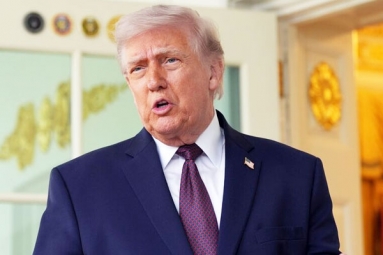
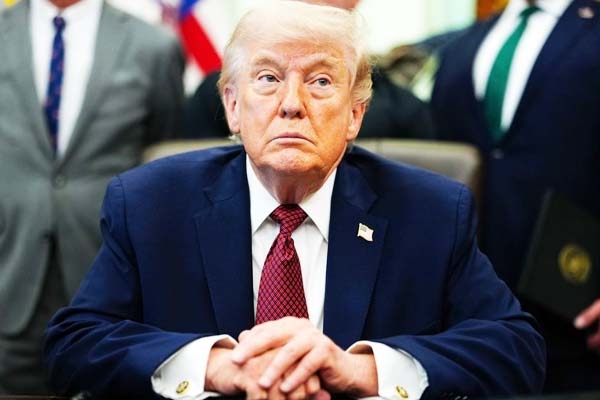
(Image source from: AP)
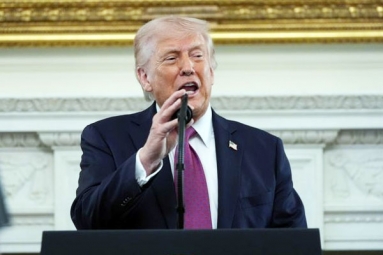
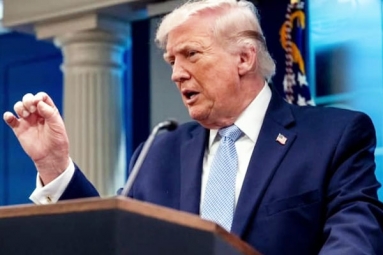
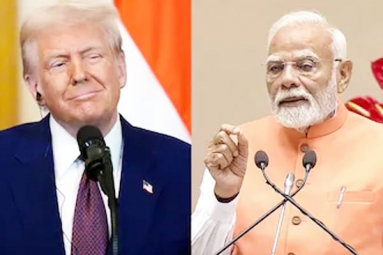
US President Donald Trump on Thursday postponed his deadline for attacks on Iran's energy resources to April 6, mentioning it was due to a request from Tehran and that negotiations were "going very well. " Trump had previously rejected claims that he was overly eager for an agreement to conclude the Middle East conflict, even though the Islamic republic showed little enthusiasm for an American peace proposal. "Negotiations are ongoing and, contrary to false claims made by the Fake News Media and others, they are progressing positively," Trump shared on his Truth Social platform.
Last Saturday, Trump had set a 48-hour deadline for Iran to allow oil tankers passage through the important Strait of Hormuz, threatening to obliterate its power facilities, but he has now postponed that deadline twice. "In line with the request from the Iranian Government, please consider this notice as a pause on the destruction of Energy Plants for an additional 10 days, moving the deadline to Monday, April 6, 2026, at 8 P.M., Eastern Time," he posted.
Trump's representative Steve Witkoff reported in a cabinet meeting earlier about "strong signs" indicating that Tehran was prepared to discuss terms, publicly confirming for the first time that Washington had relayed a list of 15 action points to Tehran via officials in Pakistan. "We will observe where this will go, and if we can persuade Iran that this is a pivotal moment with no favorable options available for them, besides further loss and devastation," Witkoff explained. In the meantime, the Iranian news agency Tasnim reported: "Iran officially sent its response to the 15 points proposed by the US last night through intermediaries, and is now waiting for a reply from the other side".
The Tasnim news article, quoting a source whose name is not disclosed, indicated that Iran's response demanded the halt of US and Israeli assaults on Iran and on groups supported by Tehran in other areas, including Hezbollah in Lebanon. It stated that reparations for war should be compensated and that Iran's control over the Strait of Hormuz must be honored, presenting demands from Tehran that exceed what is included in the US plan. During a broadcast meeting at the White House, Trump fluctuated between making extreme threats to "wipe out" Iran and suggesting that it was close to giving in. "They are eager to reach an agreement. The reason for this eagerness is that they have faced serious defeats," he remarked. Trump also mentioned the possibility of the US taking charge of Iran’s oil, drawing a comparison to an agreement made with Venezuela following the ousting of Nicolas Maduro.
Trump's harsh remarks coincided with Israeli opposition leader Yair Lapid becoming the first to express concerns to his nation's government that the war was inflicting a severe impact. "The IDF is pushed beyond its limits. The government is leaving the soldiers injured on the battlefield," Lapid stated, reiterating a caution given a day earlier by military leader Lieutenant General Eyal Zamir. "The government is deploying the army into a war on multiple fronts without a plan, without the required resources, and with far too few troops," Lapid commented. In a press update, Israeli military representative Brigadier General Effie Defrin explained, "On the Lebanese front, the defensive zone we are establishing needs more IDF personnel… Hence, we require additional combat troops in the IDF."
At the cabinet gathering, Trump noted that Iran had let 10 oil tankers pass through the Strait of Hormuz as proof of its commitment to discussions. Under nearly constant attacks since February 28, Iran faced a fresh series of Israeli strikes on Thursday, one of which Israel claimed resulted in the death of the naval commander, Alireza Tangsiri, along with several high-ranking officers. Later, an AFP journalist in Tehran reported hearing aircraft overhead and three loud blasts. Iranian sources mentioned US-Israeli strikes in central cities, including Isfahan and Shiraz, as well as in Bandar Abbas in the south and Tabriz in the northwest, plus Mashhad and Birjand near the Afghan border, an area previously largely untouched. Off the coast near Bandar Abbas on Qeshm, the biggest Iranian island in the Gulf, one local told AFP through Telegram that he wished the military would not take over the location.
"The hardships people face, the poverty, and the political oppression keep worsening every year," shared Sadeq, 42. "I don’t believe that war will solve these issues, but stopping it won’t change much for us either," he added. New violence erupted in the Gulf, resulting in two fatalities from debris from an Iranian missile intercepted close to Abu Dhabi, along with drone attacks launched at both Saudi Arabia and Kuwait. Iran has aimed at countries in the Gulf that it blames for being bases for American attacks, which include strikes on oil and gas facilities. Oil prices had decreased since the previous week, but mixed signals regarding discussions caused a rise in oil prices again on Thursday.